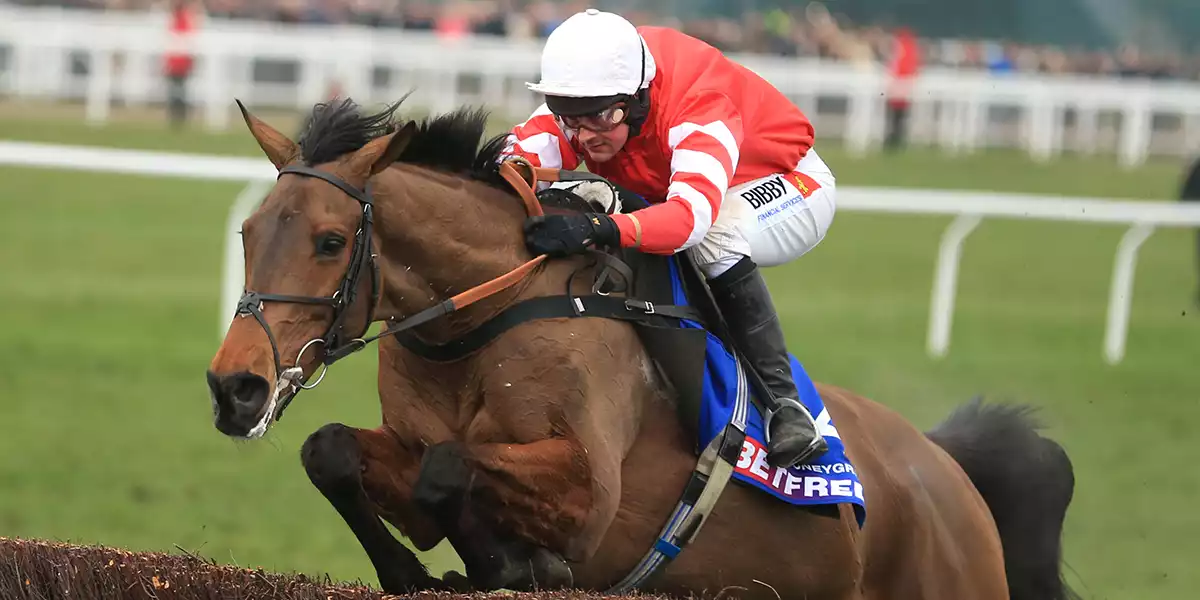
The Cheltenham Gold Cup is one of the most prestigious events in horse racing, a test of endurance, skill, and strategy that has captivated audiences for nearly a century. From its modest origins in the 19th century to becoming the crown jewel of the Cheltenham Festival, the Gold Cup has evolved into an event that defines greatness in National Hunt racing.
The Early Days: The Birth of a Racing Classic
The Cheltenham Gold Cup wasn’t always the grand spectacle it is today. Its origins date back to 1819, when a flat race of the same name was first held at Cleeve Hill, overlooking the present-day Cheltenham Racecourse. However, this version of the Gold Cup bore little resemblance to the thrilling steeplechase we know today.
The modern Cheltenham Gold Cup as a steeplechase event began in 1924, run over 3 miles and 2½ furlongs, featuring 22 fences that test both horse and jockey. Unlike its flat-racing predecessor, this new iteration quickly became a proving ground for the greatest chasers in history.
In its early years, the Gold Cup struggled for recognition, overshadowed by the Grand National, which was more widely followed at the time. However, as more talented horses and elite trainers turned their focus toward Cheltenham, the race began to earn its place in the sport’s upper echelon.
The Rise of Legends: How the Gold Cup Gained Prestige
While the race began to gain prominence in the 1920s, it was in the 1930s that the Cheltenham Gold Cup cemented itself as a premier event. Golden Miller, a name synonymous with dominance and excellence, won the race five consecutive times from 1932 to 1936—a record that still stands today. His victory in 1934, where he also won the Grand National, remains one of the most remarkable achievements in racing history.
Golden Miller’s reign brought credibility and prestige to the Gold Cup, transforming it from a well-regarded contest into a legendary race. As the decades passed, other champions would follow in his footsteps, each adding to the rich tapestry of the event’s history.
The Post-War Era and the Gold Cup Boom
Following World War II, the Cheltenham Gold Cup saw a surge in popularity, thanks to the rise of broadcasting and media coverage. The 1960s brought one of the most beloved horses in racing history: Arkle.
Arkle, trained in Ireland and ridden by the legendary Pat Taaffe, won the Gold Cup three times (1964, 1965, 1966) and remains arguably the greatest steeplechaser of all time. His superiority over the field was so absolute that the handicapping system had to be adjusted to account for his dominance.
The 1970s and 80s introduced other great champions, such as L’Escargot and Dawn Run, the latter being the only horse to win both the Cheltenham Gold Cup and the Champion Hurdle.
During this period, the Gold Cup transitioned from just a race to an institution, drawing international attention and setting the stage for its continued growth in the modern era.
The Modern Era: Racing’s Ultimate Test
The 1990s and 2000s saw a new wave of champions that continued to elevate the Gold Cup’s prestige. Best Mate, who won three consecutive Gold Cups (2002-2004), became a household name, proving that the dominance of past legends like Golden Miller and Arkle was still possible in the modern age.
Perhaps one of the most emotional victories came in 2015, when Coneygree became the first novice chaser to win the Gold Cup since 1974. This unexpected triumph proved that underdogs still have their place in Gold Cup history, adding yet another unforgettable chapter to the race’s legacy.
The past decade has also seen standout performances from Al Boum Photo, who won back-to-back Gold Cups in 2019 and 2020, and A Plus Tard’s dominant win in 2022, further solidifying the race’s reputation as the ultimate test of endurance, class, and heart.
Why the Cheltenham Gold Cup is Special
The Cheltenham Gold Cup isn’t just another race—it’s a symbol of greatness. While other races may offer bigger prize money, few can match the prestige, history, and difficulty of winning the Gold Cup.
Here’s what makes it unique:
- A True Test of Stamina and Skill – Unlike flat races, the Gold Cup requires a horse to have both speed and stamina, making it the ultimate challenge.
- A Legacy of Champions – From Golden Miller to Arkle, from Best Mate to Coneygree, each winner cements their place in history.
- The Cheltenham Atmosphere – The roar of the crowd as the horses approach the final fence is one of the most electrifying moments in sports.
The Future of the Cheltenham Gold Cup
As the festival continues to evolve, new stars will emerge, ready to etch their names into the history books. With advances in training, breeding, and race tactics, the Gold Cup is bound to remain a showcase of supreme equine ability and human expertise.
But one thing will always stay the same: winning the Cheltenham Gold Cup is the dream of every National Hunt trainer, jockey, and owner. The journey to Gold Cup glory may be long and challenging, but for those who achieve it, immortality in the sport is guaranteed.